








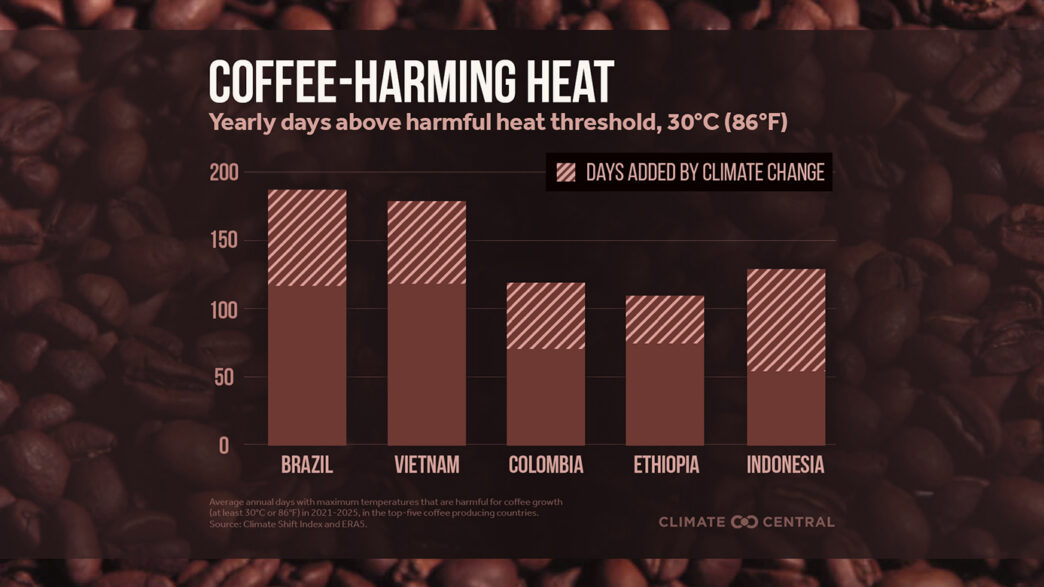
Climate change poses an existential threat to the future of coffee, and for many of us in the consuming countries, it is seen as exactly that: a future threat. The most famous stat to that end is about the year 2050, when it is projected that half of all coffee producing lands will no longer be suitable for that use. But a new study finds the effects of climate change are already here and causing nearly an additional two months’ worth of days with coffee-harming heat per year.
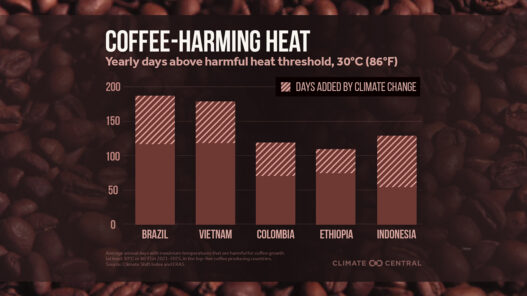
As reported by The Guardian, the report is the work of Climate Central, an “independent group of scientists and communicators who research and report the facts about our changing climate and how it affects people’s lives,” per the non-profit’s website. For it, they analyzed the number of days in coffee growing regions where the temperature went beyond 30°C (86°F) for the years between 2021 and 2025. They then used “ERA5 reanalysis temperature data” and “utilized counterfactual temperatures” from their own Climate Shift Index estimates to assess how many of those days are the direct result of carbon pollution.
30°C represents the high end of the optimal temperature range for Robusta trees, though they can tolerate higher in smaller doses. Arabica meanwhile has a maximum tolerance at around 27°C. Going above optimal growing temperatures will result in additional stress on the tree and a reduced quality in the crop.
They found that an average of 57 additional days with temperatures above 30°C annually the five top producing countries—Brazil, Vietnam, Colombia, Ethiopia, and Indonesia—that comprise a total of 75% of global production. Brazil, for instance, saw a 60% increase, going from 117 total days of excessive heat to 187. Indonesia saw the greatest percentage increase, over 130%, from 56 to 129.
Further compounding climate-related problems is the fact that, per The Guardian, smallholder farmers account for anywhere between 60% and 80% of global coffee production while only receiving .36% of the funds being used to adapt to climate change.
The extent of the damage caused by the additional days of excess heat is not quantified but the trend is alarming. The Coffee Belt is heating up. Not in some theoretical future. Not in 2050. Right here and now.
Zac Cadwalader is the managing editor at Sprudge Media Network and a staff writer based in Dallas. Read more Zac Cadwalader on Sprudge.