







This is the 18th year of Sprudge—our 18th anniversary is coming this fall—and that means it’s been 18 years of daily publishing on the topic of coffee. We’re very lucky and fortunate and blessed to do this work, and we owe it all to our readers and partners who have supported the site through innumerable wider changes and swings to the culture of coffee, the culture of media, and the fundamental underlying quintessence of journalism and publishing today. Across those 18 years it’s been my honest pleasure and privilege to write or co-write many thousands of stories for this website, and to edit many thousands more alongside our small, brilliant team. There is nothing to complain about—we are hashtag blessed—but there is, today, one thing that I feel the unassailable urge to in fact complain about fulsomely and in complete relief, and that is the use of the term “beans”.
This is not a new gripe. This did not come up today, once, in passing conversation amongst our team, the tenor of which inspired this essay. In fact, it may shock you to learn that we have been talking about this amongst ourselves at Sprudge for years—for more than a decade, in fact—harping, dissecting, kvetching and otherwise assailing the use of the common plural noun “beans” to describe the coffee seed in either its roasted form (“whole bean”) or green, raw state (“green bean”).
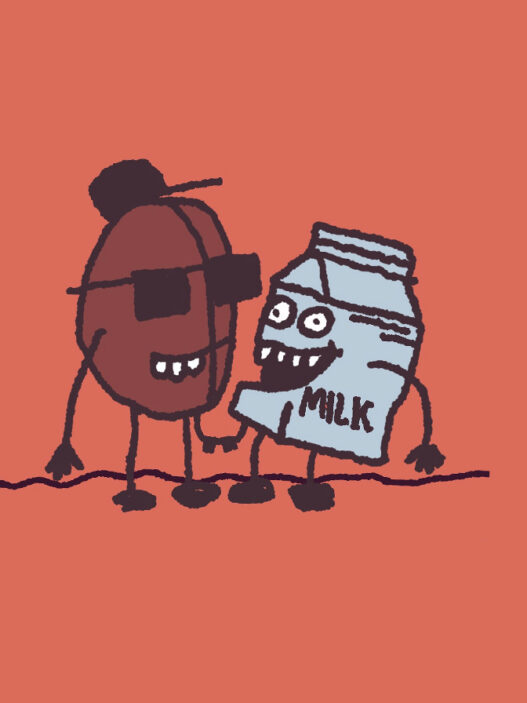
This essay has been plotted in various forms since the waning days of the Obama administration. Please understand we have hashed out and argued and perhaps wasted a bit of time considering every curve and concave of this thing. Because it’s kind of more complex than it seems, and at the end of it all I may very well fail to persuade you. In this you would not be alone; Zachary Carlsen, who I co-founded Sprudge with in the long, long ago, remains deeply dubious about my bean gripe (“What’s your beef with beans?” and “Not this again” and so forth) and is in fact shaking his head right now, reading these words, whilst simultaneously also thinking about how to photoshop Buzzy and Spesh.
Coffee is not, and has never been, a bean. At least this is what I have been trying to argue. A bean is a legume, a thing you eat. Coffee is a seed, a drupe, a stone that grows inside another piece of fruit—it has more in common with something you’d put in a pie than something you’d put in a pot. Clearly calling it a “bean” is one of these outdated malapropisms, rooted in misaligned thinking dating back to the bad old days of coffee’s global colonial cultivatorial roots. We should be calling it anything else but a bean.
This is only sort of true.
And yet. The word “bean” is defined by Merriam-Webster’s as being “the seed of any of various erect or climbing plants (as of the genera Phaseolus and Vigna) of the legume family other than the fava bean.” I don’t know why the fava bean gets such a generous mention, but whatever—it is clear that this definition does not include coffee, which is a small tree or shrub (there is also much debate about what to call that) in the family Rubiaceae. It is not and has never been a climbing plant. But it is, evidently, an “erect” plant (more power to ya), and so it might generously meet this definition in a liberal application of terms. MW goes on to further define “bean” as being “an immature bean pod used as a vegetable,” a “valueless item,” or “any of various seeds or fruits that resemble beans or bean pods” — for which it specifically cites “coffee beans” as an exemplar.
So I can’t argue against beans on any technical or linguistic grounds. Coffee *is* a bean, unfortunately, but only in the sense that it has been referred to as one for so long, and that usage is so accepted, that it gets its own carve out in the dictionary. It isn’t a legume, it doesn’t come from a bean pod, but we’ve called it a bean for so long the English language itself throws up its hands and sighs and says sure.
It has been a long road for me to also throw up my hands, sigh, and say sure. Two years ago, the last time I got all hopped up on the topic, I texted Peter Giuliano of the Coffee Science Foundation and I asked him if he’d ever researched the etymology of why we called them beans in the first place. In typical Peter Giuliano fashion, he had in fact done exactly that, and shared with me Pocke’s translation of “The nature of the drink kauhi, or coffee, and the berry of which it is made,” which likely offers the first use of the term “bean” dating back to 1659. Pocke was a professor of Arabic at Oxford, and his translation was likely influential. Meanwhile, the great early coffee historian Ukers (you should know your Ukers) speculated that popular use of the word “bean” may have come from Arabic words like “bunn” and “bunchum”, which is how the plant was referred to in Yemen.
In this text chain, which, again, is from two years ago, I tried valiantly to convince Peter that calling coffee “beans” was cringe and anachronistic, and sort of felt like it was holding coffee back, in a way, from being rightly valued and considered as having derived from fruit in the first palace. Peter pointed out this was hardly the only linguistic oddity in the English language related to food: kernels of corn are not kernels, grains of wheat are not grains, pits of olives are not pits, and seeds of chia are not seeds. Expand this out across a thousand years of language and you’ll find a thousand more examples; last night, my daughter asked me what the difference was between a “lake” and a “sea”, which led us together down a rabbit hole of the many ways in which language and meaning are applied across cultures and great distances, to which she furrowed her brow and replied, at the end of it all, “that’s weird.”
She’s right. It is weird. (My daughter did not exist when this website was founded; I have disliked the term “beans” longer than she has been alive.) Coffee is not a bean but coffee is not *not* a bean. Coffee is a bean but it is also not, remotely, a bean. It’s not my point to police language or to tell people to “stop calling them beans” although that phrase, stop calling them beans, was once the proposed title of this essay (“Stop Calling Them Beans”), which would have probably done well on Instagram, where rage and opprobrium are the guiding ontological pathways. Zachary, in his kindness and positivity, has pointed out that dozens of going concern coffee brands use the word “bean” quite happily in their names. And so if we were to come out and say, point blank, “Stop Calling Them Beans Already” or something cheeky like that, we would be in effect besmirching the good name of a thousand hard working companies who’ve done no wrong. I of course do not want to do that. I of course will listen to Zachary.
But I can’t get over the fact that I hate the word “beans” as it refers to coffee. Hate it hate it hate it. There’s something cathartic about it getting it out there, though I must wonder if this feels like something of a great reveal to the countless freelancers and contributors over the last decade who have seen the word unceremoniously excised from copy filed to this website. Because while we would never go as far as edicting a formal ban on the use of the word “bean” or “beans” on the website Sprudge, we’re not above doing a bit of pruning. A snip snip here, a snip snip there. When you say “beans” in coffee writing, you are almost always saying too much: you could simply call it “coffee”, which is already plural, or refer to “roasted coffee” if you wanted to specify coffee seeds that had not yet been ground or brewed. If you must use an additional noun, go ahead and try out “seeds”—I bet you we would publish it—or for fun, a word like “drupe” (although this is imperfect, as it refers to the whole cherry). Nearly every single time you go to write the word “coffee beans,” another word works better, or simply omitting the “beans” noun as an additional functional suffix works best of all. You can call it a “bag of coffee.” You don’t need to say “bag of coffee beans.” You can call it “whole roasted coffee.” You don’t need to say “whole bean coffee.”
I kind of think our adherence to the word “beans” devalues the whole thing, and is a living anchor to coffee’s commodity status that the specialty coffee industry has worked so hard to escape. I kind of think it’s inaccurate, or at least it feels less than accurate, and I kind of think it’s cringe. To be very clear: this is the editorial opinion of Jordan Michelman, author of this essay, and not the opinion of the Sprudge Media Network or any of its subsidiaries, contributors, advertisers, staff or associated well-wishers, with the exception of the site’s managing editor Zac Cadwalader, who does also share my dislike for the term.
It would be wrong of me to say “Stop Calling Them Beans” because who died and made me King Tut, next to whom’s tomb you can now drink delicious coffee? But it does present a different potential for a paradigm shift, one that I will leave you with as a thought exercise: what if we stopped calling them beans? What if we just… stopped using the term? Does the term bother you as much as it bothers me? Do you care, at all, even remotely? Would you like to sound off in the comments below, which is something websites like this one used to say 18 years ago, when there were many more websites like this one, which is roughly around the same time I started to notice the term “beans” and how annoying it was for coffee, at least to me?
Will this essay do remotely anything to move the bean needle? How many times can I type the word “beans” in a story about how much I don’t care for beans? Beans beans beans beans beans. I have measured out my life in coffee spoons. I have measured out my life in coffee beans.

Jordan Michelman (@suitcasewine) is a co-founder and editor at Sprudge Media Network. Read more Jordan Michelman on Sprudge.