







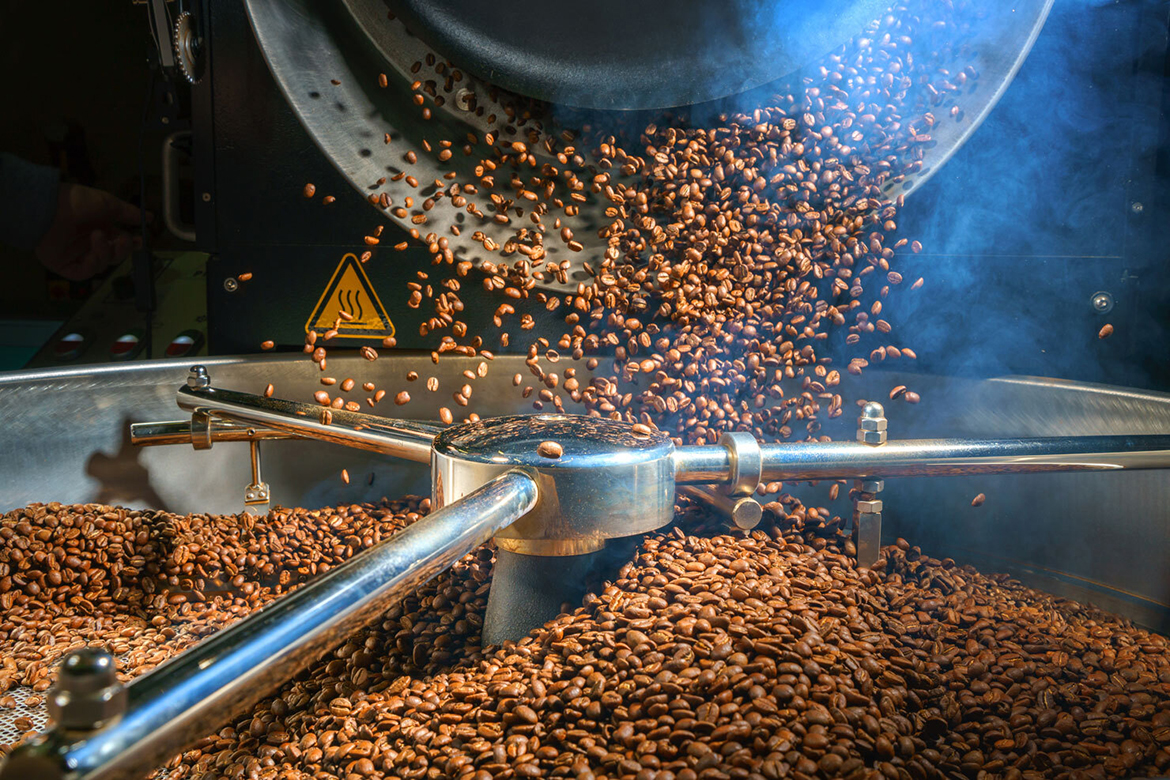
What is light roast and what is dark roast? Ask 10 different coffee roasters and you’ll get 10 different answers. But the truth of the matter may be in the color. And a new study finds that all Arabica coffee follows the same general color curve during roasting.
As reported by Phys.org, the new research was published recently in the journal Scientific Reports and is the work of the folks at the UC Davis Coffee Center examining the color dynamics of roasted coffee. Color is one of the main indicators of progress used when roasting coffee, but even with measurements like Agtron scores, what the color of a coffee represents is often subjective.
Previous research into fluctuations in color during roasting have been undertaken in static environments, like laboratory ovens, where a stable temperature is held. Which is not how commercial coffee roasters operate; heat gets applied at different rates at different parts of the roast.
To better understand how fluctuations in heat as well different origins impact color, the researchers selected seven distinct roast profiles and roasted the same washed Ugandan coffee for each in a 5g Probat. Each roast lasted 16 minutes, and the researchers took color measurements ever minute, producing a total of 17 for each roast. The also selected a subset of roast profiles and roasted a washed Indonesian coffee and a honey-processed Salvadoran coffee for a total of three roasts each. All roasts were done in triplicate, giving the researchers a total of 39 roasts and 663 color samples.
Using the L*a*b* color space, which is “a scientific color system designed to match human visual perception,” the researchers categorized the colors of each of the samples. They found that, regardless of roast curve or origin, all coffees followed “the same fundamental pathway in the L*a*b* color space.” Despite differences in how heat was applied, all coffees displayed roughly the same L*a*b* color values at notable points in the roast, like first and second crack.
Researchers were able to take these findings and predict the color of another coffee (based on parameters like time and temperature) with a 93% accuracy. They then tested their findings even further, analyzing color data from 20 different publications for a total of 392 different data points. Using the universal curve, they found that 86% of all analyzed roasts exhibited “no perceptible color differences from the predicted values.”
Further, they found that a similar color curve in bread baking, another process that utilized the Maillard reaction for browning.
The researchers hope that their findings can help standardize roast levels industry-wide. They are currently working on converting their universal color curve to already extant roast level scales, like Agtron and Colorette. This can help provide a common language for all roasters to access in order to bring uniformity to how roast levels are discussed and marketed, which will in turn decrease confusion among consumers.
The full study can be found here.
Zac Cadwalader is the managing editor at Sprudge Media Network and a staff writer based in Dallas. Read more Zac Cadwalader on Sprudge.